
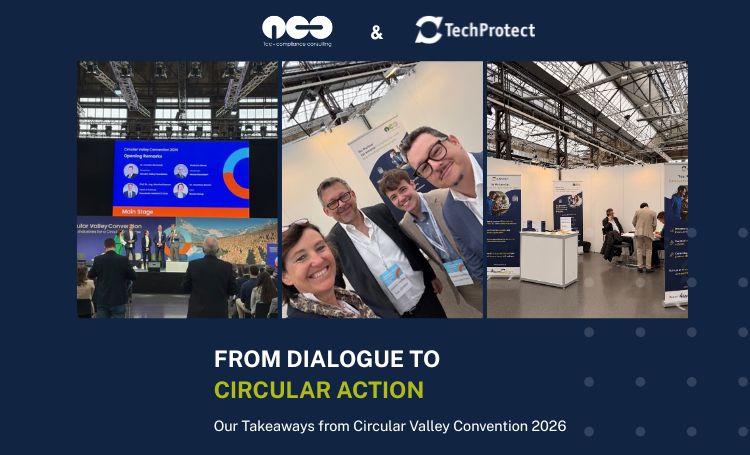
The Circular Valley Convention 2026 in Düsseldorf once again showed just how much circular economy is gaining importance across industries. After two inspiring days, we are taking away valuable impressions, new perspectives, and above all the clear sense that circularity is no longer a niche topic.
What stood out most to us was the diversity of participants on site. Companies, associations, public institutions, and many other stakeholders made it clear that circular economy is increasingly being understood as a shared field of action. This kind of exchange between different perspectives is essential for developing ideas further and creating practical, workable solutions.
One of the main topics in many conversations was reverse logistics. As resources become scarcer, the question of how products can be taken back, reused, refurbished, or recovered is moving further into focus. What was particularly striking was that many manufacturers who had not previously engaged deeply with the topic are now starting to look at it much more seriously. The discussion is therefore moving beyond pure compliance and becoming more concrete, more operational, and more strategic.
At the same time, the event also highlighted one major challenge: the economic viability of circular solutions. Circular economy can only scale if the underlying models are not only environmentally meaningful, but also economically feasible. This becomes especially clear when it comes to second-life products. If refurbished or reused products ultimately become more expensive than new ones, scaling quickly reaches its limits.
Another strong impression was the momentum around digital solutions. Many exhibitors presented approaches designed to improve how product-related sustainability data can be captured, structured, and disclosed in a more targeted way. This was particularly visible in product- and sector-specific, QR-code-based concepts related to future Digital Product Passports (DPPs). While further standardisation is still needed, it is already clear that the market is moving strongly in this direction.
For us as a compliance service provider, this development raises an important question: what role can and should we play in assessing legal requirements and helping companies navigate these evolving frameworks? Especially at the intersection of regulation, product data, and practical implementation, we see considerable potential for guidance and support.
The event also confirmed that topics such as take-back, reuse, refurbishment, and recovery are becoming increasingly central. Companies are actively looking for concrete ways to translate circular ambitions into functioning processes. This is where we see an important role for ourselves: helping connect regulatory requirements, operational feasibility, and practical solutions.
Our conclusion after two intensive days in Düsseldorf is clear: personal exchange remains a key driver for advancing circular economy. Events like the Circular Valley Convention help make major future topics more tangible, encourage open discussion of challenges, and support the identification of concrete next steps.
We are taking away many valuable conversations and impulses, and we feel confirmed in what we strongly believe: circular economy needs dialogue, practical solutions, and a shared willingness to turn ambition into implementation.