
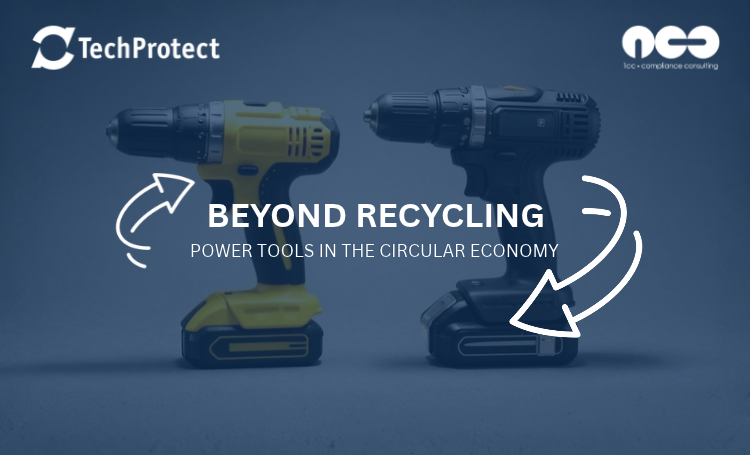
Even after a new power tool has been purchased, manufacturers still face the challenge of managing used equipment and batteries. Alongside regulatory obligations, the circular economy and customer retention are becoming increasingly important.
Whether through trade-in campaigns or battery take-back initiatives, structured programs ensure that used products are returned to established collection and treatment processes. Achieving this requires a coordinated approach that brings together legal requirements, program design, and operational implementation.
Trade-In, Battery Take-Back or Compliance: Defining Clear Objectives
Take-back programs serve different purposes. Trade-in incentives encourage customers to replace older equipment while strengthening customer loyalty. Battery take-back programs support the proper handling of used batteries, while circular economy objectives and legal obligations also play an important role.
Requirements vary depending on the program’s purpose. A voluntary trade-in campaign involves different participation conditions and processes than a legally mandated take-back system. Manufacturers should therefore define their objectives, obligations, and operational procedures at an early stage.
WEEE and the EU Battery Regulation: Assessing Obligations Early
Depending on the product and target market, power tools and batteries may be subject to regulatory requirements under the Waste Electrical and Electronic Equipment (WEEE) Directive and the EU Battery Regulation, among others. Key aspects to assess include producer responsibilities, product classification, collection requirements, and national obligations.
These requirements influence factors such as retailer involvement, the acceptance of specific products, and their subsequent treatment.
1cc supports manufacturers in assessing requirements arising from Extended Producer Responsibility (EPR), WEEE legislation, and battery regulations, and incorporating them into the design of take-back programs.
Collection, Pickup and Recycling: Organizing Take-Back Operations
A trade-in campaign for cordless power tools at specialist retailers illustrates how such a program can work in practice: customers return their old equipment when purchasing a new product.
To make this possible, clear processes must be established for collection at retail locations, pickup, treatment of tools and batteries, and the transfer of recyclable products to suitable recycling facilities.
TechProtect supports manufacturers and retailers with product take-back, reverse logistics, and recycling. By coordinating product returns and subsequent treatment, TechProtect helps combine convenient, customer-facing take-back services with reliable operational processes behind the scenes.
1cc and TechProtect: Connecting Compliance and Logistics
Overlooking legal requirements can create compliance risks. At the same time, even a well-designed, regulation-compliant program can fail within retail or service networks if practical collection and logistics processes are missing. Both perspectives must therefore be considered from the outset.
1cc: Regulatory Assessment and Program Design
1cc evaluates regulatory requirements, clarifies responsibilities, and develops take-back concepts that take producer obligations and circular economy objectives into account.
TechProtect: Product Take-Back, Reverse Logistics and Recycling
TechProtect organizes practical product take-back operations, collection and reverse logistics, and coordinates recycling processes.
Together, these complementary areas of expertise enable a coordinated approach to product take-back.
Circular Economy: Taking a Holistic View of Product Life Cycles
Structured take-back programs create pathways for used power tools and batteries to undergo appropriate further treatment. The most suitable option depends on the condition of the product and the processes available. Recycling is particularly important when further use is no longer possible.
However, the circular economy goes beyond recycling. It also aims to make product life cycles and material flows more resource-efficient.
As part of a broader product life cycle strategy, take-back programs can bring together regulatory responsibility, customer retention, and the responsible management of end-of-life products.
Trade-in and battery take-back programs offer opportunities for manufacturers and retailers, but they require clearly defined legal and operational processes.
1cc contributes regulatory expertise and program design capabilities, while TechProtect supports product take-back, reverse logistics, and recycling.
Are you planning a trade-in or battery take-back program for professional power tools?
Discover how 1cc and TechProtect can support you, from regulatory assessment through to operational implementation.