
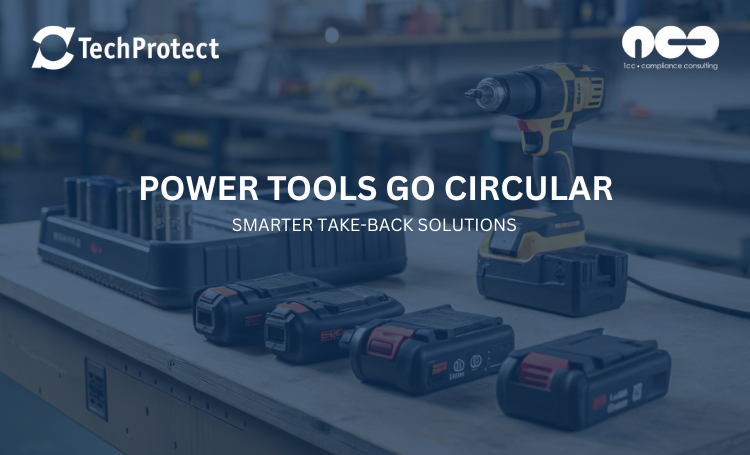
For manufacturers, an important question arises: What happens to power tools and their batteries when they are no longer in use?
Take-back programs can help establish structured processes for collecting used equipment, support recycling, and create additional opportunities to strengthen customer relationships. However, implementing such programs also raises regulatory questions.
For manufacturers selling their products in European markets, the challenge lies in understanding the different requirements applicable to electrical equipment and batteries and incorporating them into a practical take-back solution.
Power Tools and Batteries: Which Legal Requirements Apply?
A cordless drill may be sold as a single product. From a regulatory perspective, however, the electrical equipment and the battery it contains are subject to different legal frameworks.
In the European Union, the Waste Electrical and Electronic Equipment (WEEE) Directive establishes requirements for the collection and treatment of waste electrical and electronic equipment.
The EU Batteries Regulation (EU) 2023/1542 provides a separate legal framework for batteries. Among other things, it sets out requirements for extended producer responsibility, the collection of waste batteries, and their management.
Both regulatory frameworks may be relevant to manufacturers of professional power tools.
The specific obligations depend on several factors, including the product category, the market in which the products are sold, national legal requirements, and the company’s role within the supply chain.
An important distinction must also be made between electrical equipment intended for private households and equipment intended exclusively for professional users. This classification can affect the applicable WEEE obligations as well as the organization and financing of take-back activities.
Batteries also require careful classification. A battery is not automatically considered an industrial battery simply because it is used in professional equipment.
Understanding these distinctions is an essential prerequisite for developing an appropriate take-back program.
Planning Take-Back Programs: What Obligations Must Manufacturers Consider?
Trade-in programs, in which customers return an old device when purchasing a new product, as well as battery take-back or exchange programs, can be effective measures for strengthening customer loyalty.
However, a voluntary commercial take-back program does not automatically fulfill all statutory take-back obligations.
Manufacturers must assess which legal obligations apply independently of the program itself and whether the planned take-back channels, processes, and responsibilities comply with the relevant requirements.
Key questions include:
- Which WEEE and battery-related obligations apply in the respective target markets?
- How should the products and batteries concerned be classified under the applicable regulations?
- Who bears legal responsibility for collection, financing, treatment, and reporting?
- What requirements apply when involving dealers or service partners?
- How should the take-back of electrical equipment and the collection of batteries be organized?
- Which documentation and reporting obligations must be considered?
Addressing these questions during the planning phase can help manufacturers avoid regulatory gaps and reduce the risk of having to modify operational processes at a later stage.
From Collection to Recycling: Designing Compliant Take-Back Processes
If customers can return used cordless drills through a network of specialist dealers, the program must define how equipment and batteries are accepted, stored, collected, and transferred for further treatment.
Depending on the type and condition of the returned batteries, specific requirements relating to safety, handling, and transport may apply.
Responsibilities among manufacturers, dealers, logistics providers, and recycling partners must also be clearly defined.
A well-designed take-back concept therefore combines regulatory analysis with practical considerations relating to collection points, logistics, further treatment, and documentation.
This is particularly relevant for manufacturers operating in several European countries, as national regulations and organizational frameworks may differ between markets.
Reuse and Recycling: Unlocking the Potential of Take-Back Programs
Through organized take-back channels, manufacturers establish the basis for directing used devices and batteries to appropriate treatment processes.
Depending on the condition of the product, technical feasibility, and applicable regulatory requirements, different downstream pathways may be considered, such as preparation for reuse or recycling.
In this context, the dangerous goods regulations governing the transport of batteries and rechargeable batteries (both separately and permanently installed in devices) must also be taken into account. Particular attention must be paid to specific transport and packaging requirements, as well as to whether simplified provisions, such as Special Provision 188 for certain lithium batteries, can be applied.
Meeting WEEE and Battery Obligations: How 1cc Supports Manufacturers
1cc supports companies in understanding and implementing regulatory requirements relating to electrical and electronic equipment, batteries, and extended producer responsibility (EPR).
For manufacturers of professional power tools, this may include assessing relevant WEEE and battery obligations, identifying responsibilities across different markets, and developing take-back concepts based on regulatory requirements.
By considering compliance requirements from the initial concept development stage, manufacturers can establish a reliable foundation for subsequent operational implementation.
A clear understanding of applicable obligations helps manufacturers define responsibilities, select suitable take-back channels, and establish practical processes.
This creates the foundation for take-back programs that support both regulatory compliance and broader circular economy objectives.
Are you planning a take-back program for professional power tools or batteries?
Get in touch with us